

On September 1, the Royal Canadian Navy (RCN) conducted the inaugural flight of its first uncrewed aircraft system, the CU179 Peregrine, at the Canadian Forces Maritime Experimental and Test Ranges (CFMETR) near Nanaimo, British Columbia.
Based on the Schiebel S-100 helicopter drone, an internationally proven platform, the CU179 Peregrine is designed to operate from warships. It will initially be integrated aboard Halifax-class frigates before transitioning to River-class destroyers as they enter service.
The Advanced Naval Capabilities Unit conducted the launch and recovery of the CU179 Peregrine. The activities demonstrate the Canadian Navy’s progress in developing its maritime drone capability following years of planning, collaboration, and testing.
The helicopter is equipped with advanced sensors, wide-area surveillance payloads, and long-range radar. The uncrewed aircraft will provide the Royal Canadian Navy (RCN) with additional maritime surveillance capabilities and support situational awareness and decision-making. Its integration into the fleet will also support missions to monitor Canada’s waterways and conduct search and rescue operations while reducing the need to expose personnel to operational risks.
With the addition of the CU179 Peregrine, the RCN joins a growing number of navies using uncrewed aviation systems to maintain maritime security and operational effectiveness.
The system will also support closer interoperability with Canada’s defence partners.
To remind, MDA Space was awarded two contracts in August 2025 to provide the Royal Canadian Navy with uncrewed aircraft systems under the Intelligence, Surveillance, Target Acquisition and Reconnaissance (ISTAR UAS) project. The contracts cover the initial procurement of two systems, with options for up to four additional systems.
The acquisition contract is valued at approximately C$39 million, while a separate in-service support contract is estimated at C$27 million over an initial five-year period. The support arrangement includes provisions for extensions of up to 20 years.
The ISTAR UAS systems are being introduced to expand the RCN’s ability to detect and monitor maritime activity and potential threats. Initial operational capability is expected in 2028, followed by full operational capability in 2032.
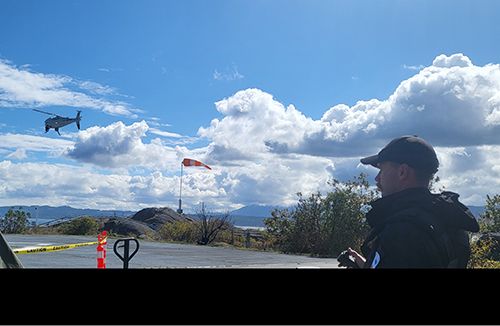
A Royal Canadian Navy operator remotely controls the CU179 Peregrine drone during its first flight; Credit: Canadian Navy