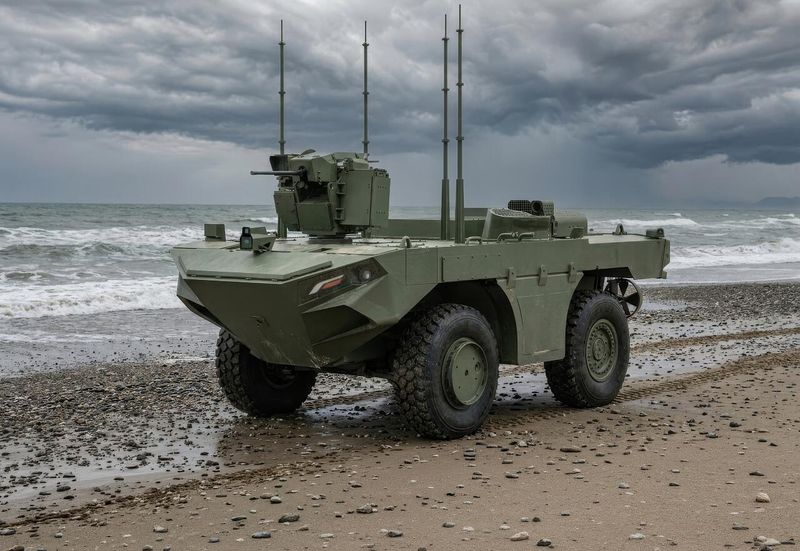
Turkish defense company FNSS has unveiled an 8-ton unmanned amphibious vehicle designed to operate ahead of manned forces during the highest-risk phase of amphibious assault operations.
The company presented its new multi-purpose modular unmanned amphibious vehicle (U-MAV) at TEKNOFEST Mavi Vatan 2026, held at the Gölcük Naval Shipyard Command in Kocaeli, Türkiye, from August 20 to 23.
Amphibious assault is among the most demanding and highest-casualty-risk operations in the full spectrum of warfare. According to FNSS, İ-ZAHA is designed to take the crew out of the first wave, which is the highest-risk phase of any amphibious assault, and to operate as part of a manned-unmanned team (MUM-T) with the Marine Assault Vehicles (MAV) already in service with the Turkish Naval Forces Command.
At an amphibious combat weight of 8 tonnes, U-MAV is powered by a 300-horsepower powerpack and can reach speeds of 7 knots in the water and up to 70 km/h on land. The company noted that the vehicle is designed to transition from sea to shore without interruption.
"FNSS continues to grow its work and its R&D investment in unmanned and autonomous vehicle technologies. U-MAV brings together our engineering capability, the field success of the Marine Assault Vehicle (MAV) and our continuing R&D effort in a new-generation, heavy-class unmanned amphibious vehicle. Very few companies worldwide can build an unmanned amphibious vehicle of this size and capability. With more than 35 years of experience in the industry and an active production line able to build several different platforms concurrently, FNSS is one of a small number of NATO suppliers that can do so. I am proud to say that U-MAV opens a new era for FNSS," FNSS CEO and Board Member Selim Baybaş said.
A key feature of the new vehicle is its modular architecture, which allows mission payloads to be changed in approximately 40 minutes in field conditions. FNSS said the common platform can support ten different mission configurations, including fire support, mine clearance, combat engineering, electronic warfare, reconnaissance, deception, counter-drone operations, navigation and obstacle marking, logistics support, and casualty evacuation.
Multiple U-MAV variants can also operate together during the same mission while sharing a common platform and sustainment infrastructure.
For command and control, the vehicle uses an encrypted mesh network, GNSS/INS navigation, and an IFF identification module. Its inertial navigation capability is designed to maintain position estimates when satellite navigation signals are degraded or denied.
The vehicle has a line-of-sight communications range of 3 kilometers, which can be extended through UAV relay support. In the event of a datalink interruption, U-MAV can transition to a safe hold state before either returning to base along a pre-programmed route or continuing its navigation task, depending on its mission configuration.
FNSS has also equipped the platform with AI-enabled image processing technology that analyzes camera feeds onboard and transmits detection data rather than high-bandwidth video streams. Detected elements are tagged with threat scores, type, and status using colour-coded overlays and detailed intelligence cards. Automatic target detection and fire control systems accelerate the engagement cycle by presenting prioritised targets to the operator, reducing scanning burden; all detected targets are tracked and recorded with timestamps. A newly defined target type or engagement rule can be applied instantly to the live imagery feed in the field, it was highlighted.
Another feature is the integration of Nurol Teknoloji’s Armor Integrity structural monitoring system. According to FNSS, sensors can detect the location, direction and severity of an impact, assess the remaining structural capacity of the affected area and monitor accumulated damage over time.
With no crew to assess a hit, the system replaces human judgement. Its sensors detect an impact's location, direction and severity in real time, calculate the affected area's remaining structural capacity, track latent damage that accumulates over time, and transmit to the operator and chain of command.
Using real-time data and systematic tactical analysis, it offers the commander options: manoeuvring to protect the weakened area, taking cover, continuing the mission, or a passive role. If the connectivity is lost, data is stored locally and sent on reconnection, so the decision cycle from operator to tactical planning and logistics support is fed without interruption.